Monday, 11 November 2013
FISH PIE
Another comforting classic for this chilly weather. There are endless variations - some people use prawns and scallops as well as fish, some include chopped up boiled eggs or capers but mine is very straightforward. Just smoked haddock and cod in a parsley sauce topped with mashed potato and a sprinkling of parmesan.
This is something I make quite often so I will just give an idea of quantities as we go along.
I generally make this pie in advance as I find that it is best to let the sauce/fish mixture cool a bit. If you put the potatoes on top of the sauce whilst it is hot the potato seems to melt into the sauce and it all becomes a bit of a gooey mess. If the potato goes on the sauce when it has cooled the layers stay more distinct.
First of all the fish. I allow a medium sized fillet of fish per person and generally a third smoked fish to unsmoked. Put the fish in a wide shallow pan with around 500ml milk. Bring up to the boil and simmer for five minutes until just cooked. Remove the fish, break up into big chunks and put in the bottom of a buttered baking dish. Season with salt and white pepper.
Make the white sauce with the milk that the fish has been poached in. I use around 50g butter and the same of flour for a four person pie. Melt the butter, stir in the flour and cook that through then gradually add the milk, bring to the boil and whisk until smooth and thickened. You may need a bit more milk if the sauce is very thick as it needs to be the texture of thick custard. Stir in the juice of half a lemon and a big handful of chopped parsley. Pour over the fish.
Peel some potatoes, allowing a large potato per person. Cut into chunks and boil for 20 minutes until tender. Strain, mash the potatoes, add a splash of milk, a knob of butter and a generous shake of white pepper and beat until smooth.
As the fish and sauce mixture is quite unstable it is best to take spoonful's of the potato and dot over the top, then gently join the dots of potato up with a fork. Leave a hole in the potato in the centre. Sprinkle the top of the pie with a little cayenne pepper and finely grated parmesan.
Cook at 180 degrees for 45 minutes until bubbling. This pie takes a long time to cook through so use the hole in the mash topping to check that it is hot all the way through.
I think peas are an ideal accompaniment to this dish and perhaps some broccoli.
Sunday, 10 November 2013
AVOCADOS WITH CRAB
Avocado, crab and a bit of crunch - what more could you ask for? This is a really simple but very effective dish. Two halves make a good lunch and one half makes a lovely starter. For two people for lunch you need 2 ripe avocados, 200g white and brown crabmeat, a tablespoon of cream, handful of dried breadcrumbs and a tablespoon of grated parmesan.
This is unusual because it is a warm avocado dish. Put the oven on at 180 degrees.Slice the avocados in half and remove the stone. In a small bowl combine the crabmeat, a good pinch of cayenne pepper, black pepper, pinch of salt and the cream and fold together. Spoon the mixture equally into the avocado halves, sprinkle with the breadcrumbs and grated parmesan.
Cook for 10 minutes then either put under the grill or turn your oven up to crisp off the parmesan and breadcrumbs. Delicious.
Tuesday, 29 October 2013
BACON AND ONION PUDDING
I have an unhealthy weakness for suet puddings. The classic, of course, is steak and kidney but my favourite has to be this one - bacon and onion. For the filling I use a pack of 'cooking' bacon from Morrisons. These are the offcuts left over when they slice up their rashers, all the little odds and ends. The quality is the same as the ordinary bacon and while we aren't talking artisan dry cured it is definitely good enough for this pudding. Do have a sort through them first as they can be irregular sizes - it is best to have them in fairly uniform 1cm-ish bits.
Unlike a steak and kidney pudding this one doesn't generate its own gravy so a separate one has to be made. When I was growing up it was made with half a packet of dried chicken and leek soup, a method I still use today. However, I had run out of soup so I had to make one from scratch - I use a chicken Oxo cube instead of proper stock simply because I think it works.
Pastry
200g plain flour
100g shredded suet
2 tsp baking powder
Pinch of salt
1 tsp dried sage
Cold water
Filling
500g cooking bacon, in small pieces
1 medium onion finely chopped
1 tsp dried sage
Gravy
Finely chopped shallot
Chicken Oxo
1 tbsp flour
250ml water
2 tbsp cream
Grease a 1 litre pudding basin. In a roomy bowl mix together the flour, suet, baking powder, salt and sage. Add enough water to make a pastry that is softer than shortcrust pastry but still capable of being rolled out. Divide the dough into a third and two thirds. Dust your board and roll the larger piece out until it is big enough to line your pudding basin, then transfer to the basin and press carefully into the bottom.
Combine the bacon, onion and sage and tip into the lined basin. Roll out the remaining pastry into a top to fit the basin, brush the edge of the pudding with water then press on the top. Trim the edges.
Take a sheet of greaseproof paper and a sheet of tin foil. Put the tin foil on top of the greaseproof paper then fold an inch pleat in both. Place this over the pudding and tie with string tightly (useful to have a friend near at this point!). Steam the pudding for 2 and a half hours.
To make the gravy slowly fry the shallot in a knob of butter until it starts to disintegrate. Stir in the flour and then the water until it thickens. Crumble in the Oxo cube and stir until a nice thick gravy has formed - a little more water might be needed. Just before serving add the cream and bubble up.
Once the pudding has cooked turn it out onto a plate. Serve with a little bit of mashed potato, a green vegetable (kale is lovely with this) and a generous glug of the gravy. Perfect for winter nights.
Sunday, 27 October 2013
AVOCADOS, PRAWNS, CRAB AND SMOKED SALMON VARIATIONS
I always have smoked salmon and raw king prawns in my freezer - they freeze well and (more importantly) thaw out well! Throw in some avocado, tomato, coriander, shallot and a variety of starters or light lunches are at your finger tips. Below is a nest of smoked salmon strips on top of roughly chopped avocado, tomato and coriander, dusted with paprika and dressed with a little olive oil and lemon.....
This one is avocado crushed with lime juice and chopped coriander, brown crab meat mixed with a little mayonnaise and white crabmeat on top, dressed with olive oil and lime juice, served with pea shoots and chopped parsley and chives.
And here we have tiger prawns that have been deveined so that they curl up prettily, briefly fried in a little garlic infused olive oil, seasoned and set aside to cool. They then sit on a top of a bed of finely sliced lettuce, and chopped tomatoes and avocado. Dress the whole thing with a lemon and olive oil and a few chilli flakes.
POACHED PEARS
I am temporarily (I hope) out of work so I have absolutely no excuse not to get back to putting things that I cook on my blog. This is a nice light pudding (I really dislike the word dessert for some reason), ideal for after a heavy lunch. It is easy to do, you can prepare it well in advance and there are lots of variations you can make.
The most important point is to make sure that your pears are slightly under ripe otherwise they will collapse when poached. Conference pears are best but make sure they are fat enough as in this recipe the core is removed before poaching.
Serves 4
Pears
4 largish Conference pears or similar hard pears
150ml water
100g sugar
150ml white wine
3 cloves
I orange sliced
Chocolate sauce
100ml double cream
2 tbsp. cocoa powder
Tablespoon golden syrup
Knob of butter
Filling
150 ml cream
50g dark chocolate grated
Nibbed pistachios
Peel the pears and carefully hollow out the core from the bottom. Scrunch up some tin foil and put in the hole so that the pear doesn't collapse while poaching. Put the water, sugar , cloves, orange slices and white wine in a saucepan big enough to hold the pears, add them and bring to a gentle simmer. Cook for 20 minutes until tender. Remove the pears and let them cool.
To make the filling whisk the cream up until thick then fold in the grated chocolate. You can add some chopped nuts if you like.
Heat the cream, thoroughly stir in the cocoa powder, syrup and butter and beat until shiny.
Once everything is cool fill the pears with the cream mixture, settle each one on a plate, pour over the chocolate sauce and sprinkle with the pistachios.
The most important point is to make sure that your pears are slightly under ripe otherwise they will collapse when poached. Conference pears are best but make sure they are fat enough as in this recipe the core is removed before poaching.
Serves 4
Pears
4 largish Conference pears or similar hard pears
150ml water
100g sugar
150ml white wine
3 cloves
I orange sliced
Chocolate sauce
100ml double cream
2 tbsp. cocoa powder
Tablespoon golden syrup
Knob of butter
Filling
150 ml cream
50g dark chocolate grated
Nibbed pistachios
Peel the pears and carefully hollow out the core from the bottom. Scrunch up some tin foil and put in the hole so that the pear doesn't collapse while poaching. Put the water, sugar , cloves, orange slices and white wine in a saucepan big enough to hold the pears, add them and bring to a gentle simmer. Cook for 20 minutes until tender. Remove the pears and let them cool.
To make the filling whisk the cream up until thick then fold in the grated chocolate. You can add some chopped nuts if you like.
Heat the cream, thoroughly stir in the cocoa powder, syrup and butter and beat until shiny.
Once everything is cool fill the pears with the cream mixture, settle each one on a plate, pour over the chocolate sauce and sprinkle with the pistachios.
Tuesday, 21 May 2013
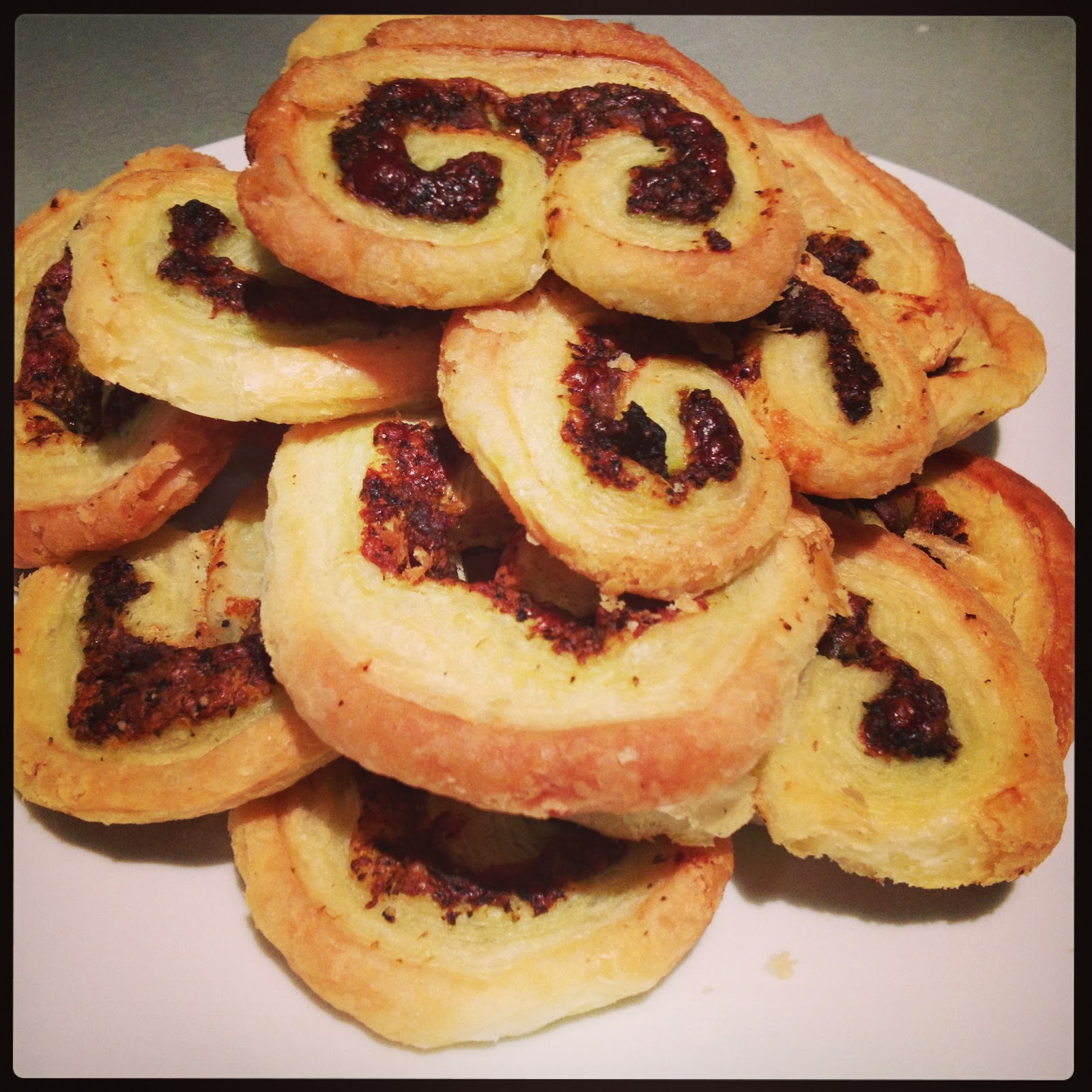
SAVOURY PALMIERS
Mr Redding is very fond of sweet palmiers - Wiki defines them thus: 'Palmiers are made from puff pastry, a laminated dough similar to the dough used for croissant, but without the yeast. Puff pastry is alternating layers of dough and melted butter. The puff pastry is rolled out, coated with sugar, and then the two sides are rolled up together so that they meet in the middle, making a roll that is then cut into about 1/4" slices and baked. Usually it is rolled in sugar before baking.' Whilst being associated with France different varieties occur across Europe.
I quite like sweet palmiers but generally prefer savoury to sweet and was reminded of a palmier recipe that Delia had in her Christmas book that contained parma ham. Anyway, I had some wild garlic pesto left over and some shop bought puff pastry so I thought I would experiment.
Making palmiers is all about the construction. Take a ready rolled sheet of puff pastry that is roughly square. Spread with pesto ( ordinary is fine but I had made some delicious wild garlic pesto - take an ordinary recipe and substitute wild garlic and rocket for the basil), then line anchovies up in two lines roughly equidistant. Srinkle a generous handful of grated parmesan over the whole lot along with a good grind of black pepper. Starting at one side roll up tightly as if you were rolling a swiss roll until you get to the middle. Turn the pastry round and do the same with the other side. Wrap the resulting roll in cling film and rest in the fridge for at least 30 minutes.
Once the pastry has chilled pre-heat your oven to 220 degrees. Slice into approx. 50mm slices and place on a baking sheet covered in baking parchment, leaving lots of space between them. Bake for around 15 minutes until crisp, golden brown and bubbling.
These are a brilliat drinks nibbles and, having a little more body than many, enable two decent cocktails to be consumed before dinner. Enjoy.
Once the pastry has chilled pre-heat your oven to 220 degrees. Slice into approx. 50mm slices and place on a baking sheet covered in baking parchment, leaving lots of space between them. Bake for around 15 minutes until crisp, golden brown and bubbling.
These are a brilliat drinks nibbles and, having a little more body than many, enable two decent cocktails to be consumed before dinner. Enjoy.
Wednesday, 15 May 2013
SCALLOPS WITH MORCILLA, BACON, BROAD BEANS AND PEAS
This is a delicious starter, quite light but full of good flavours - the saltiness of the bacon and earthiness of the beans and peas complement the sweetness of the scallops.
I love scallops, both the big fat King scallops and the sweet little Queenies. I find them to be a very useful thing to keep in the freezer for impromptu starters - yes, I know I should buy everything fresh from my local fishmonger (the excellent Sopers on Nunhead Lane) but I'm busy with lots of stuff and good quality frozen scallops are ok by me.
This isn't an original recipe, we have all seen variations on the theme of black pudding, scallops, broad beans, peas, but it is very easy to prepare - no purees or emulsions here, just lovely ingredients cooked quickly.
Again, I apologise that I can't give much idea about quantities because lately when I have been cooking I have been doing so out of pleasure and to feed people. Per person I would allow 2 large or 3 small King scallops, a handful of frozen broad beans and peas, 3 inches of morcilla sausage and a small handful of smoked lardons.
So, how to do it....
Pour boiling water over the broad beans, leave for a couple of minutes, then remove the outer skin of each bean. Cook the beans and peas for 2-3 minutes in boiling water until just done. Set aside.
Put a splash of oilve oil in a small frying pan, allow to heat up and add the lardons. Once they are looking browned and crispy add the morcilla and brown. Add the peas and beans and a splash of balsamic vinegar to create a dressing - taste and check for seasoning then keep warm.
Heat up a frying pan, add some olive oil and get smoking hot. Put in the scallops, and cook for a minute or so each side (depending on size) until just cooked. These are best served in small shallow dishes with the morcilla and bacon dressing on the side.
Subscribe to:
Posts (Atom)